How AI-Native Software Delivery Addresses SDLC Bottlenecks
Date
November 18th, 2026
Reading Time
7 mins
Tags cloud
What's news
Key Takeaways
- Traditional software development often struggles with several challenges, including fragmented requirements, repetitive tasks, disconnected handoffs and delayed validation. These issues create risks of inconsistent delivery and unnecessary rework.
- To overcome these challenges, an AI-Native Software Development Life Cycle (SDLC) integrates AI capabilities with project knowledge, engineering workflows and human oversight.
- Building on this concept, UPP MASS (Multi-Agent Software Studio) brings AI agents, developers and testers into a unified, context-aware delivery process.
- The key feature of UPP MASS is governed software delivery, supported by human approval, quality gates, traceability and controlled AI execution.
- Together, these capabilities help enterprises reduce avoidable rework, maintain software quality and strengthen delivery accountability while retaining control over engineering decisions.
Introduction
Although AI agents can generate code in seconds, it raises the important question of who holds the responsibility for ensuring that each alteration complies with project requirements, receives thorough human review and remains traceable. Independent coding agents often lack persistent project context, which can lead to inconsistent changes, repeated work and disconnected reviews.
UPP MASS (Multi-Agent Software Studio) addresses these challenges through an AI-Native SDLC that connects AI agents, developers, and testers within a governed delivery workflow. By combining project context, scoped execution, human approval and traceable validation, UPP MASS helps enterprises adopt AI-assisted development without losing control over software quality and delivery decisions.
>> Read more: Multi-Agent System: How It Works & When to Use It (Part 1)
Why Independent AI Coding Agents Fall Short
Fragmented Requirements and Project Knowledge
In many software projects, requirements are often scattered across various platforms like emails, chat messages, meeting notes, and project management tools. User stories may lack clear acceptance criteria or a consistent source of truth, making it difficult to align implementation with business expectations.
Moreover, project knowledge frequently relies on a handful of experienced team members. While independent AI coding agents can access repository files, they often miss the broader requirements, architectural decisions and historical context needed to make consistent changes.
Repetitive Development and Disconnected Handoffs
Developers often find themselves spending valuable time trying to understand unfamiliar codebases, writing boilerplate and resolving recurring issues. Although AI agents can assist with these tasks, their isolated execution does not automatically solve the coordination issues between business analysis, development and testing.
As requirements and code evolve, documentation, test artifacts and related project records can quickly become outdated. Without synchronised handoffs, teams risk duplicated work, inconsistent implementation and additional rework.
Late Validation and Limited Delivery Control
Testing is often left until late in the development cycle, when the scope of regression has expanded and resources for testing are limited. Security and integration testing may also be delayed, make it harder to identify and address issues before delivery.
Additionally, delivery information is typically spread out multiple systems, complicating project managers' ability to monitor progress and risks in real time. Independent AI coding agents alone cannot resolve these challenges without connected workflows, defined review gates and reliable traceability.
To overcome these bottlenecks, enterprises need an AI-Native SDLC that integrates project requirements, engineering activities, quality assurance and human oversight within a governed delivery process.
How UPP MASS Addresses These Challenges
UPP MASS tackles five common challenges that organizations face when integrating AI agents into enterprise software delivery:
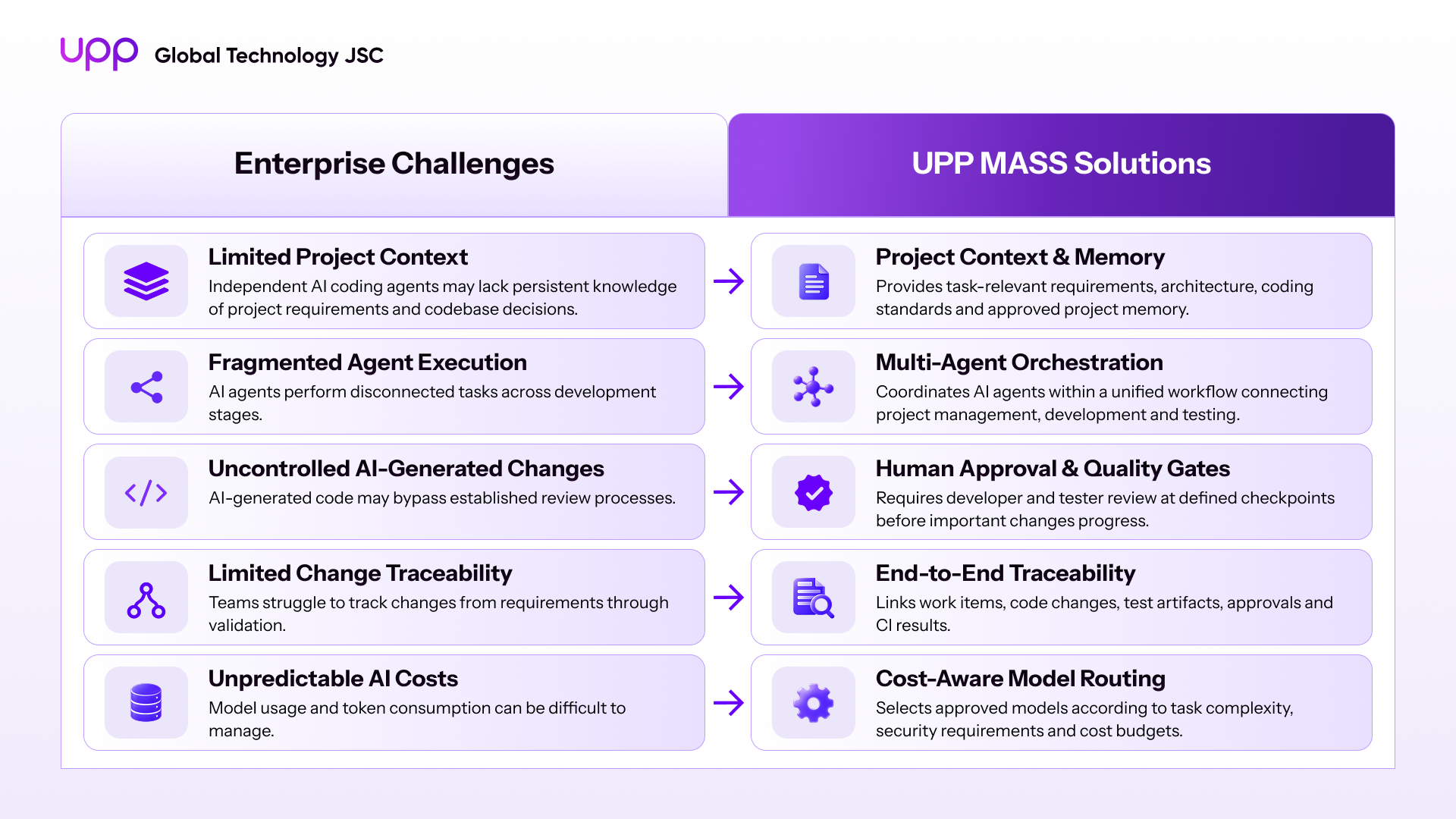
These capabilities position UPP MASS as a structured solution for governed software delivery, bridging the gap between AI-assisted engineering with the controls and accountability that enterprises need.
Unified AI-Native Software Delivery
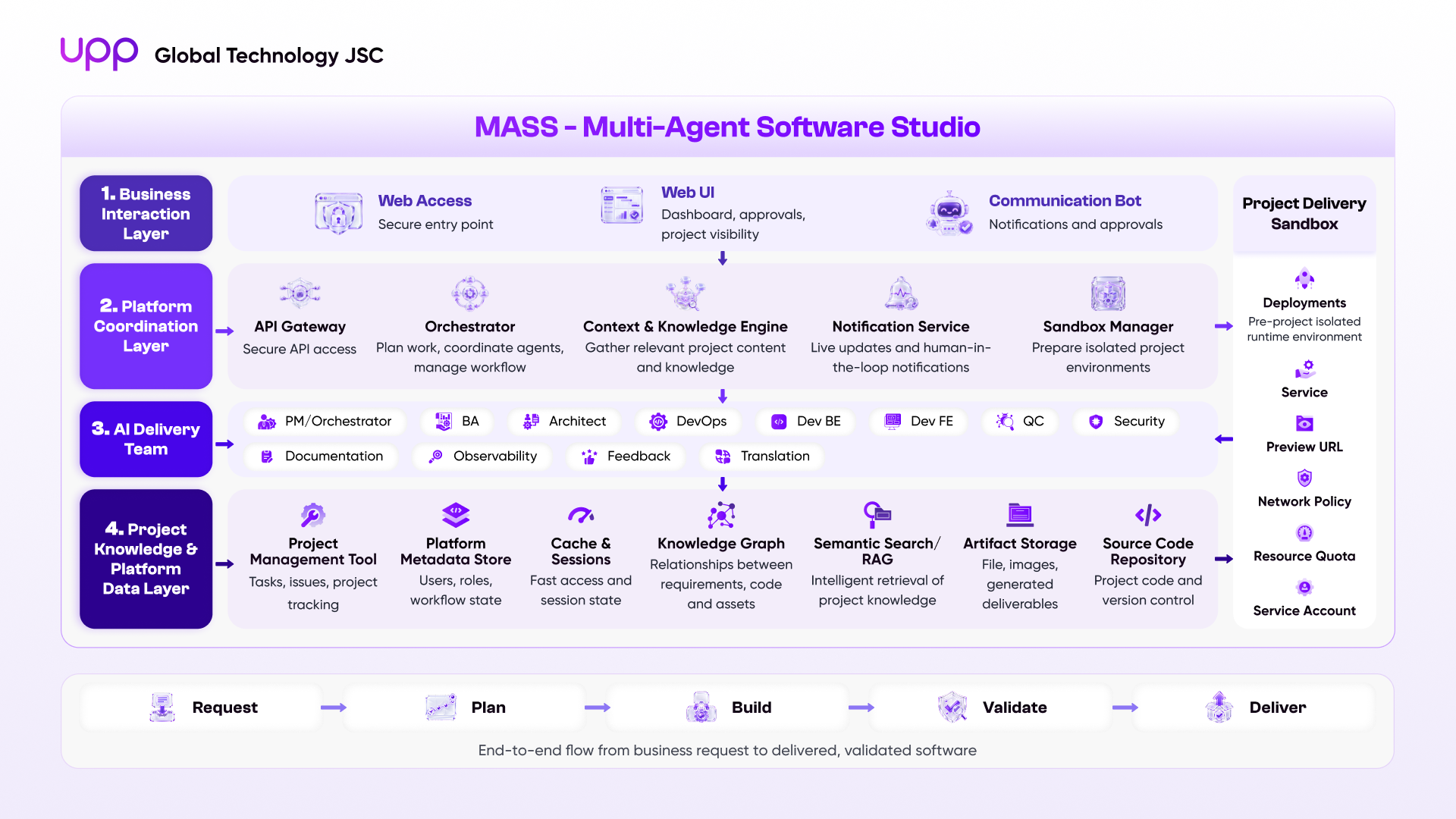
UPP MASS is UPP's innovative solution that integrates AI agents into a structured software development framework. This enhances collaboration among AI agents, developers, and testers, ensuring an efficient process governed by human oversight. Each project team at UPP includes an AI Delivery Team that acts as a digital teammate, understanding project context, adhering to policies, and coordinating tasks from requirements to coding, testing and Git/CI.
Instead of deploying coding agents as isolated assistants, MASS connects project management, development and quality assurance through a unified orchestration layer. Its goal is to facilitate AI-native software delivery while ensuring accountability throughout the entire development lifecycle.
Context-Aware AI Agents
One of the standout features of MASS is how it manages engineering context. The platform draws on work items, requirements, relevant source code, architectural decisions, coding standards, approved test artifacts, and project memory.
Context is selected according to each task and its permissions rather than loading the entire repository into every AI request. This approach helps agents forcus on information that's relevant to the current change while maintaining consistency with previously approved project decisions.
Governed Multi-Agent Execution
UPP MASS also supports multi-agent engineering within well-defined execution boundaries. AI can analyse requirements, investigate issues, prepare implementation plans, suggest code changes and assist with testing.
However, important actions remain subject to human approval and verification. The solution is designed to complement existing project management tools, Git repositories, and CI pipelines rather than replace established engineering ownership. This makes MASS a practical choice for organizations looking to introduce AI into their existing delivery processes without treating autonomous execution as a substitute for governance.
>> Read more: Multi-Agent Orchestration: How AI Agents Communicate, Coordinate, and Work Together (Part 2)
Governance and Risk Controls in UPP MASS
Scoped Execution and Human Approval
An effective AI-Native SDLC requires clear boundaries around what AI agents can access, modify and execute. UPP MASS implements permission-based controls and task-specific execution policies, ensuring that agents operate within authorized project environments.
Its documented default autonomy model emphasizes recommendations, drafts and execution with approval. Sensitive actions, such as making significant changes or submitting code, require relevant human checkpoints. This approach supports governed software delivery without removing engineering accountability.
Traceability and Quality Gates
Human code review is one part of a broader verification process. MASS connects work items, implementation plans, code versions, test artifacts, approvals and CI results through an auditable record. AI-generated changes must satisfy the applicable quality gates before being considered validated.
The system also differentiates between proposed or unverified changes and those backed by test evidence. Developers and testers remain responsible for reviewing critical outputs, while security policies restrict high-risk operations and unauthorized access to project information.
Cost-Aware Model Routing
Governance also extends to model selection and AI spending. Through the Enterprise Model Gateway, MASS supports cost-aware routing across different model tiers, choosing capabilities according to task complexity and approved data policies.
Features like selective context retrieval, token budgets, caching and limits on agent execution loops help control unnecessary AI usage. Enterprises can configure supported provider accounts or self-hosted models based on their infrastructure and security needs. The goal is to manage cost per successfully validated workflow, rather than minimizing token consumption at the expense of software quality.
How UPP MASS Delivers Business Value
Reduced Rework and Clear Ownership
The business value of UPP MASS lies in its ability to connect AI-assisted engineering activities to a consistent delivery process. By aligning requirements, code changes, review decisions and test evidence, MASS aims to reduce avoidable rework caused by incomplete context or inconsistent handoffs.
Its shared workflow also makes responsibilities clearer: project stakeholders approve requirements, developers are accountable for technical changes and testers validate outcomes before work is closed.
Measurable Delivery Performance
For engineering leaders, evaluating AI-native software delivery should focus on delivery quality and operational accountability, not just the volume of AI-generated code. Relevant metrics include rework frequency, first-pass quality-gate results, rejected changes, completed work items with traceable evidence and AI cost per validated workflow.
These indicators can help organizations assess whether AI assistance is improving delivery consistency while upholding engineering standards. Actual improvements should be measured against each project's baseline, rather than being assumed from the mere adoption of AI agents.
Enterprise Flexibility and Control
UPP MASS offers a structured approach for organizations looking to adopt AI-Native SDLC practices while retaining control over their existing engineering environments. Its combination of project-aware context, multi-agent coordination, human approval and configurable model infrastructure supports accountable delivery from work-item intake through Git/CI and QC validation.
Importantly, the solution's documented scope does not include autonomous deployment to production or post-production application operations; those responsibilities remain within the customer's established delivery and operations processes.
Conclusion
UPP MASS is more than just an AI coding agent, it's a comprehensive AI-Native SDLC platform that seamlessly integrates project management, development and testing within a governed workflow.
With shared project context, human approval, end-to-end traceability and cost-aware model routing, UPP MASS empowers enterprises to reduce rework, uphold software quality and maintain control over their delivery processes.
>> If you want to explore the technical details of UPP MASS, contact us.
Tags cloud
Newsletter
DISCOVER MORE





LET’S TALK...
Content delivered to your inbox


ENTER YOUR EMAIL
YOU WANT TO...


Hanoi, Vietnam
Web3 Tower, No. 15, Alley 4, Duy Tan, Cau Giay, Hanoi, Vietnam