How Agentforce Increases Patient Satisfaction by 30% in Healthcare
Date
July 29th, 2026
Reading Time
7 mins
Executive Summary
A large healthcare enterprise in Southeast Asia was struggling with fragmented patient records, high appointment no-show rates, and overloaded care coordinators. Despite having digital systems in place, critical patient information remained scattered across departments, creating delays in care coordination and increasing operational burden.
UPP Global Technology JSC implemented a Salesforce Agentforce and Agentforce Health (formerly Health Cloud) solution that unified patient timelines, automated outreach workflows, and enabled proactive chronic care coordination.
Within five months, the organization achieved:
- 30% increase in patient satisfaction
- 35% improvement in caseload efficiency
- Reduction of no-show rate from 18% to 9%
- Significant reduction in manual coordination workload
This case study explores how UPP leveraged Agentforce and Agentforce Health to connect fragmented patient information, automate care coordination workflows, and deliver these measurable improvements.
The Challenge: Patient Care Was Limited by Fragmented Information
Like many healthcare providers, the organization had invested heavily in digital systems over the years in an effort to modernize operations and improve patient engagement. They operated a multi-specialty healthcare network with thousands of patient interactions occurring across outpatient clinics, chronic care programs, and care coordination teams.
However, these systems did not work together effectively. Consequently, care coordinators often needed to manually gather information from multiple sources before contacting a patient.
Although EMR and CRM systems were already deployed, teams faced three critical operational issues.
1. Data Fragmentation
Patient histories, clinical notes, appointment records, and risk indicators were spread across multiple systems, making it difficult for care teams to quickly form a complete view of each patient. Therefore, before each patient interaction, coordinators spent significant time manually collecting and comparing information to understand the patient’s situation and determine the most appropriate next step.
As a result, response times were delayed, and the number of patients each coordinator could effectively support was reduced. Over time, this created a recurring operational bottleneck that affected both staff productivity and the consistency of the patient experience.
Impact: Approximately 20 additional minutes per patient interaction were lost to data retrieval and reconciliation activities, which meant valuable time was spent preparing for care rather than directly engaging with patients.
2. High No-Show Rate
Appointment reminders were largely manual and lacked personalization. In addition, without a scalable engagement process that could adapt to patient needs and communication preferences, many patients missed appointments, creating gaps in care while reducing operational efficiency across clinics and care programs.
Impact: The organization experienced an 18% no-show rate, which not only created gaps in chronic disease management but also reduced clinic utilization efficiency and made provider schedules harder to manage predictably.
3. Coordinator Overload
Administrative tasks consumed a large portion of the care team’s time and gradually became a barrier to higher-value clinical coordination. Instead of focusing primarily on patient engagement and care planning, coordinators spent hours navigating systems, updating records, and following up manually across disconnected workflows.
Moreover, workloads had grown significantly beyond industry benchmarks, contributing to operational inefficiencies and increasing the risk of staff burnout. This pressure made it more difficult for teams to prioritize patients who required timely intervention and continuous monitoring.
Impact: Caseload pressure contributed to burnout risk and reduced the team’s ability to focus on high-risk patients requiring proactive intervention, especially when those patients needed coordinated follow-up across multiple touchpoints.
Why Traditional Automation Was Not Enough
The organization had already automated several isolated tasks, but the underlying problem was not simply a lack of automation. Rather, the issue was that automation had been applied in fragments, without connecting the broader patient context needed to support informed decisions and coordinated action.
In other words, it was a lack of connected context, which prevented existing systems from working together as a unified care coordination environment.
Patient history, risk indicators, communication records, scheduling data, and care coordination activities existed in different systems. Therefore, staff still needed to assemble the full picture manually before making decisions, even though much of the required information had already been captured somewhere in the digital environment.
This is where Agentforce became valuable. Rather than functioning as a standalone chatbot, it acted as an AI orchestration layer across Salesforce Health Cloud, EMR systems, and operational workflows.
Read more: How Agentforce Supports Enterprise Operations
The Solution: Building an Agentforce-Powered Care Coordination Platform
To address these challenges, UPP designed and implemented an Agentforce architecture integrated with Agentforce Health (formerly Health Cloud) and the organization’s existing healthcare systems. This approach allowed the enterprise to build on its current technology investments while creating a more connected and intelligent care coordination platform.
The solution focused on three capabilities that, together, helped reduce manual work, improve patient engagement, and give care teams the operational visibility needed to manage patient populations more proactively.
1. Unified Patient Timelines
Agentforce consolidated patient information from Salesforce Health Cloud and connected EMR systems into a single view. As a result, care teams no longer needed to move between disconnected platforms to understand patient history, current needs, and potential risks.
Instead of searching multiple systems, care coordinators could instantly access the information most relevant to each interaction, including:
- Patient histories
- Appointment records
- Care plans
- Clinical risk indicators
- Previous engagement activities
This significantly reduced preparation time while improving decision quality during patient interactions. More importantly, it helped coordinators move from reactive information gathering to more confident and proactive patient support.
2. Autonomous Patient Outreach
UPP deployed AI-powered outreach agents capable of automatically engaging patients based on predefined care workflows. In this way, routine communication activities could be handled consistently and at scale, while still allowing staff to intervene when a patient required additional attention.
Depending on the workflow and patient status, the system could:
- Send appointment reminders
- Deliver follow-up communications
- Escalate non-responsive patients
- Prioritize outreach activities
- Trigger staff intervention when needed
As a result, routine engagement activities no longer required manual effort from care coordinators, which helped reduce repetitive administrative work and improved the reliability of patient communication.
At the same time, human staff remained responsible for critical decisions and high-risk patient situations, ensuring that automation supported clinical judgment rather than replacing it.
3. Proactive Chronic Care Management
One of the most impactful use cases involved chronic disease management. For chronic disease populations, the platform continuously monitored patient data and operational signals, enabling the organization to identify emerging risks earlier and maintain closer continuity of care between scheduled visits.
When predefined risk conditions were detected, Agentforce automatically initiated workflows through Salesforce Flow and OmniStudio. Consequently, coordinators could intervene earlier rather than reacting only after a missed appointment, delayed follow-up, or clinical deterioration had already occurred.
Care Coordination Dashboard
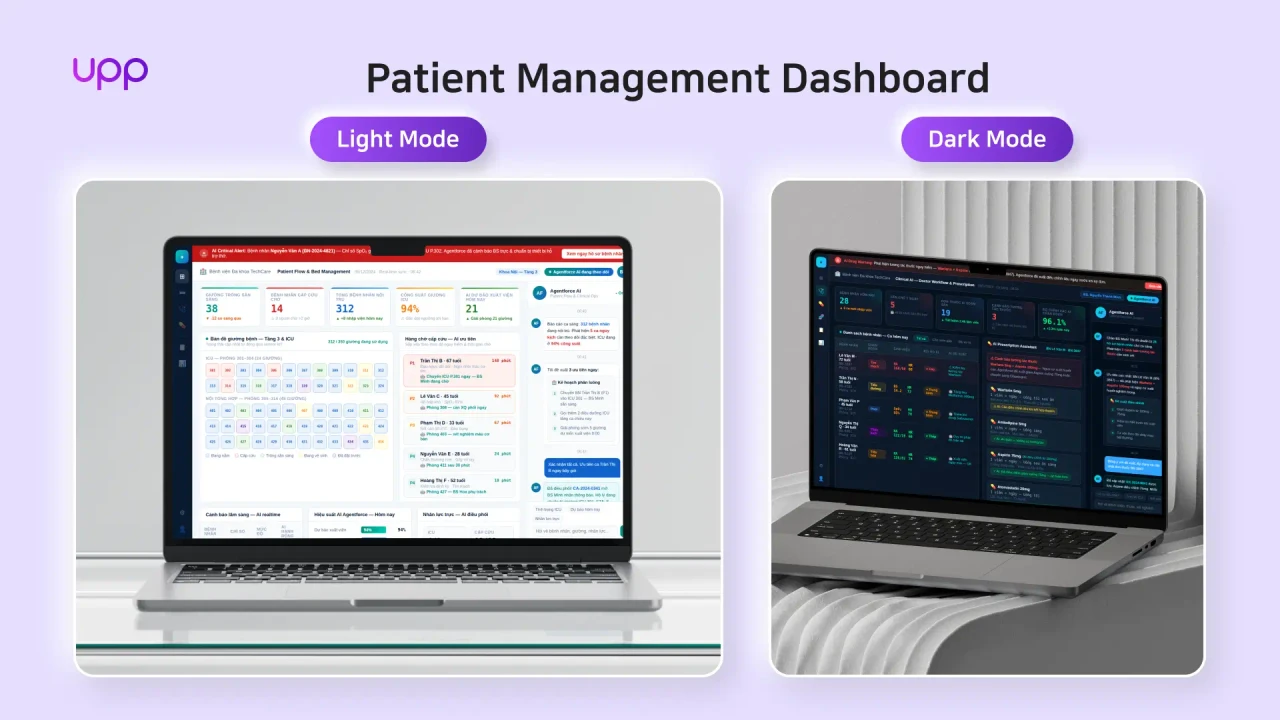
Patient Management Dashboard for Clinicians
One of the most valuable aspects of the implementation was the creation of a real-time operational dashboard for care coordination teams. By bringing patient, workflow, and workload information into one place, the dashboard gave managers and coordinators a clearer view of what required attention each day.
Specifically, the dashboard provided visibility into:
- Live patient queue monitoring
- Appointment adherence tracking
- Risk-based prioritization
- Escalation alerts
- Care coordinator workload visibility
- Workflow execution status
By presenting operational and patient data within a single interface, coordinators could focus on care delivery instead of navigating multiple systems. This also made it easier for teams to identify bottlenecks, prioritize urgent cases, and coordinate next steps across different roles.
The result was faster response times, improved workflow efficiency, and greater visibility across the patient journey. In addition, the dashboard created a stronger operational foundation for continuous improvement because leaders could monitor performance trends more consistently.
Business Outcomes
After five months of operation, the healthcare enterprise reported measurable improvements across patient experience, workforce productivity, and clinic utilization. These outcomes showed that the value of the platform extended beyond automation alone and directly supported both operational and clinical priorities.
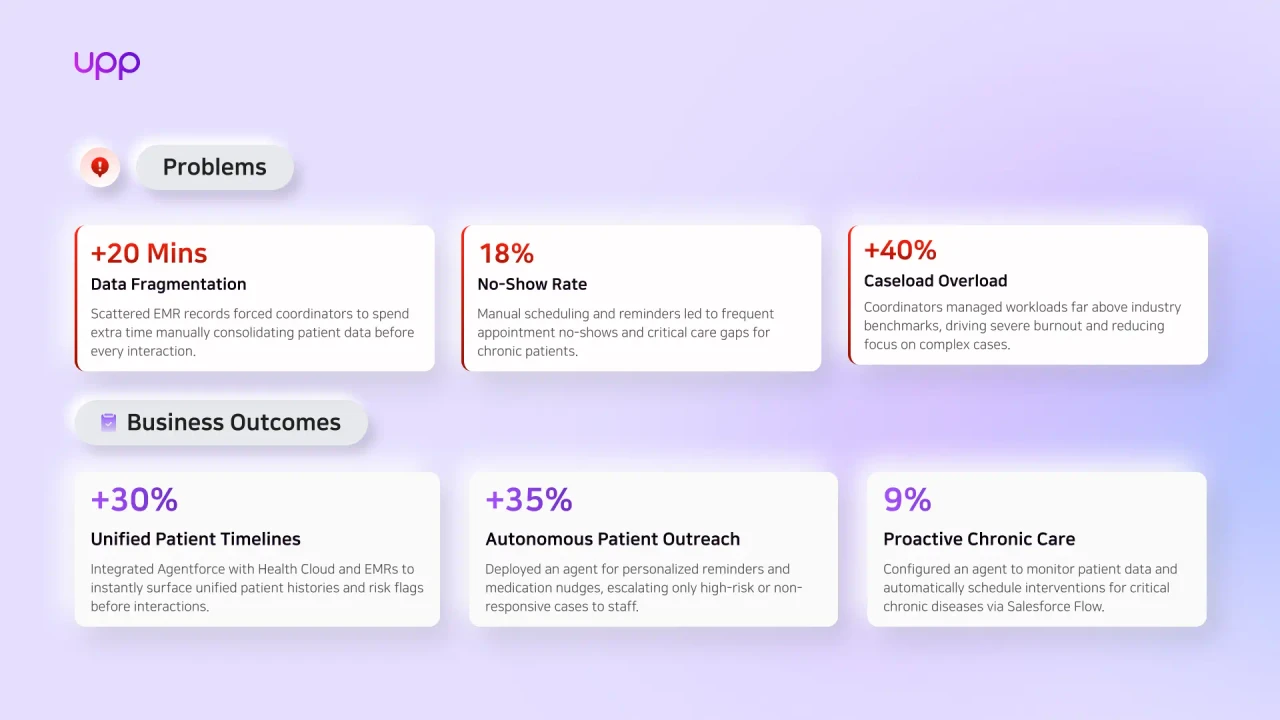
Measurable Business Impact After Agentforce Implementation
Patient Satisfaction: +30%
Faster responses, proactive outreach, and improved continuity of care led to a 30% increase in patient satisfaction scores across targeted care programs. Since patients received more timely reminders, clearer follow-up, and better-coordinated support, their overall care experience became more consistent and reliable.
Caseload Efficiency: +35%
Care coordinators were able to handle more cases per day because patient context was available instantly and routine outreach was automated. Therefore, they could spend less time preparing for each interaction and more time supporting patients who required meaningful engagement or escalation.
Average case handling time decreased significantly, allowing staff to focus on higher-value clinical coordination activities. In practice, this meant coordinators could manage larger caseloads without simply increasing workload pressure, because much of the repetitive preparation and follow-up effort had been reduced.
No-Show Rate: 18% → 9%
The reduction in no-shows represented one of the clearest ROI indicators, as it demonstrated a direct connection between smarter patient engagement and better operational performance.
By cutting the rate in half, the organization improved several important areas at the same time:
- Clinic utilization
- Revenue realization
- Provider scheduling efficiency
- Chronic care continuity
For healthcare organizations, no-show reduction creates both financial impact and clinical impact simultaneously. In this case, improved appointment adherence helped the enterprise make better use of provider capacity while also supporting more consistent chronic care management.
Key Takeaways for Healthcare Organizations
Many healthcare organizations still view AI primarily as a documentation tool, virtual assistant, or chatbot technology. However, this perspective can limit the strategic value of AI because it focuses mainly on isolated tasks rather than the broader operational challenges that affect patient access, care coordination, and workforce productivity.
This case study demonstrates a different reality. In practice, the greatest value often emerges when AI is embedded directly into operational workflows and used to coordinate actions across people, systems, and data. Instead of functioning as a separate tool, AI becomes part of the organization’s day-to-day care delivery model, helping teams respond faster, prioritize more effectively, and make better use of the information already available across the enterprise.
Therefore, successful healthcare AI initiatives typically share three important characteristics. These characteristics help ensure that AI adoption is not only technically feasible, but also practical, trusted, and aligned with the way healthcare teams actually work:
- Unified and trusted patient data
- Human oversight for critical decisions
- Workflow-driven AI deployment
Ultimately, Agentforce did not replace care coordinators or remove human judgment from the care process. Instead, it enabled care teams to work more effectively by reducing administrative friction, surfacing the right information at the right moment, and allowing staff to focus more of their time on patients who required attention, follow-up, or proactive intervention.
Conclusion
As healthcare organizations continue to explore AI, the question is no longer whether automation is possible.
The more important question is how AI can improve patient outcomes while supporting clinicians and care teams in a safe, governed, and scalable manner.
By combining Agentforce and enterprise data integration, this healthcare provider transformed fragmented workflows into a proactive care coordination model that delivered measurable business and patient outcomes.
About UPP Global Technology JSC
UPP Global Technology JSC is a leading AI Integration & Consulting Partner in Vietnam that helps enterprises connect data, AI, systems, and workflows into a unified operational ecosystem.
We help organizations move from AI experimentation to production-ready business value through strategic consulting, AI-ready data foundations, enterprise integration, and continuous AI operations.
With experience across 7+ markets, including South Korea, the United States, Australia, Germany, Singapore, Japan, and Vietnam, UPP brings global delivery standards and practical implementation expertise to enterprise AI transformation.
Explore our services to learn how AI and Salesforce can create value across your organization.
Newsletter
DISCOVER MORE

































![[Recap] UPP Global Technology JSC Establishing Anniversary](/homepage/news-section/new-4.webp)




















LET’S TALK...
Content delivered to your inbox


ENTER YOUR EMAIL
YOU WANT TO...


Hanoi, Vietnam
Web3 Tower, No. 15, Alley 4, Duy Tan, Cau Giay, Hanoi, Vietnam