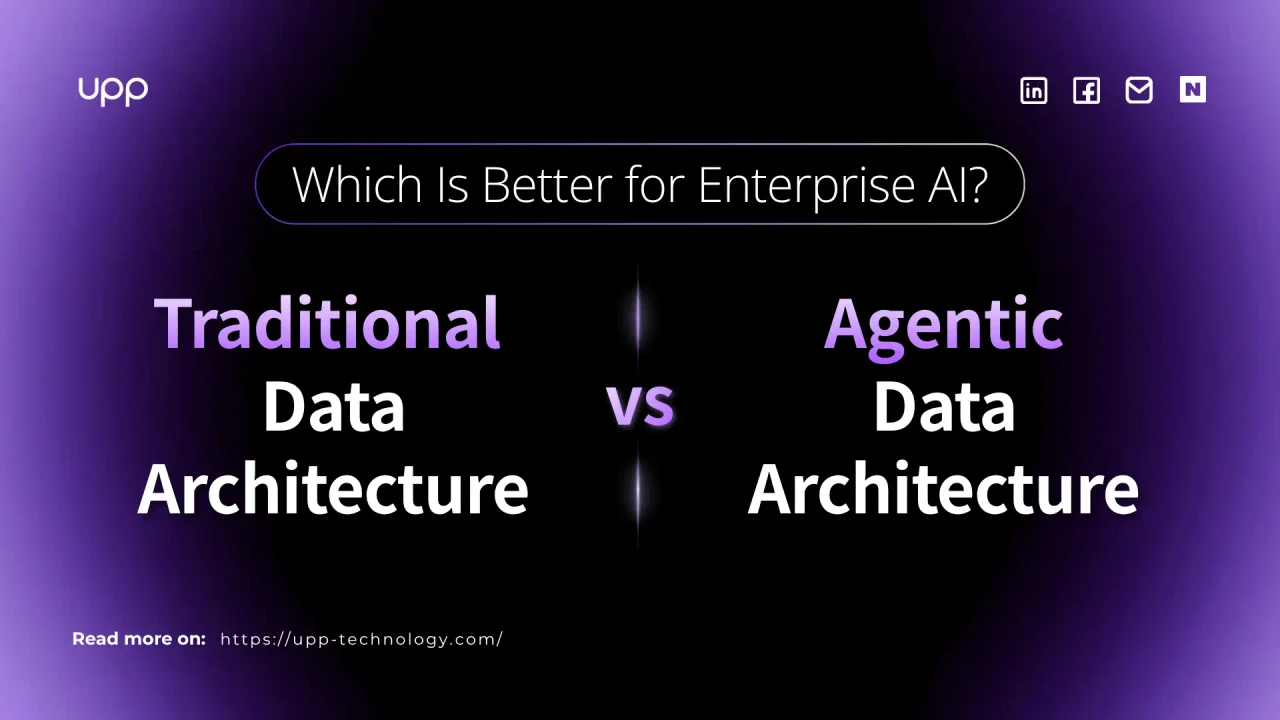
Traditional Data Architecture vs Agentic Data Architecture: Which Is Better for Enterprise AI?
Date
September 22th, 2026
Reading Time
7 mins
Enterprise AI faces a data challenge, but the real problem often lies beyond what organisations first assume.
Most enterprises already have data platforms. They have warehouses, lakehouses, integration pipelines, APIs, governance policies, access controls, and teams responsible for keeping the entire environment running. In many cases, the foundation is not missing. The real issue is that it was built for a different kind of consumer.
Traditional analytics asks for data. AI agents may need to act on it.
McKinsey reported in 2026 that nearly two-thirds of enterprises had experimented with AI agents, yet fewer than 10% had scaled them to deliver tangible value. More importantly, eight in ten companies identified data limitations as a barrier to scaling agentic AI. The problem is no longer simply whether businesses have enough data. It is whether that data can support AI systems that need to operate across workflows, systems, and decisions in real time.
That sounds like a small shift. In practice, it changes a great deal. Once an AI system can retrieve information, decide what to do next, call a tool, update a system, or hand work to another agent, the question is no longer simply whether the data is available. The business also needs to know whether the agent has the right context, the right permission, the right memory, and a safe path to action.
So the conversation around data architecture is changing. The answer, however, is not to throw away everything enterprises have already built. They need to understand what already works, where the gaps are, and what additional capabilities are required when AI moves from simply analysing information to taking action.
What Is Data Architecture in Enterprise AI?
Data architecture describes how data works across an organisation. It covers where data comes from, where it is stored, how systems exchange it, who can access it, how its quality is controlled, and how applications use it.
Think about a customer record. Part of that information may sit in CRM. Order information may live in another platform. Support history may be stored in a helpdesk system. Contracts could exist as documents, while payment information comes from a finance system.
A good data architecture helps those systems work together in a controlled and understandable way.
For traditional analytics, this usually means making sure employees, reports, and applications can access reliable information when they need it. For Enterprise AI, the same foundation remains important, but there is another requirement: AI needs to understand the context around that information.
It is not enough for an AI agent to know that a customer has an open case. It may also need to know what happened before, which policy applies, what the customer has already been told, which actions are allowed, and whether a person needs to approve the next step.
That is where data architecture starts to change.
Traditional Data Architecture: What Was It Designed to Do?
.webp)
aditional data architecture provides the structure that allows an organisation to collect, organise, store, govern, and use data across different systems. It usually connects operational applications, databases, integration pipelines, data warehouses or lakehouses, APIs, reporting tools, and governance controls into a defined data environment.
In practice, data normally moves through known paths. Information is created in source systems such as CRM, ERP, finance, or operational applications, then integrated, transformed, and stored in platforms where it can be used for reporting, analytics, applications, or machine learning. Security, data quality, metadata, and governance help ensure that the information remains reliable and is available to the right users.
One of the strengths of traditional data architecture is predictability. The organisation can define where data comes from, how it should be processed, which system acts as the source of truth, and who is allowed to access it. This makes the approach well suited to business intelligence, regulatory reporting, historical analysis, operational applications, and many AI and machine learning use cases that depend on trusted and well-managed data.
For Enterprise AI, these capabilities remain important. AI systems still need reliable sources, clear data ownership, consistent definitions, secure access, and strong governance. In many cases, the existing architecture already provides a large part of the foundation needed for AI.
The main question is therefore not whether traditional data architecture still works. It is whether the way data is currently delivered is enough for the type of AI workload the business wants to support.
Agentic Data Architecture: What Changes When AI Can Act?
.webp)
Agentic data architecture extends the data environment to support AI agents that need to work across multiple sources, understand context, maintain the state of a task, and interact with enterprise systems. Rather than replacing the existing data foundation, it adds capabilities that help AI use that foundation in a more dynamic way.
The way it works is different because the data path is not always fixed in advance. An AI agent may receive a task, identify which information it needs, retrieve data from several approved sources, use business rules or policies to understand the situation, and then decide what step should happen next. Depending on the workflow, it may also call a tool, update a system, request approval, or pass the task to another process.
This means the architecture needs to support more than data access alone. Context becomes important because the agent needs to understand which information is relevant to the current task. State and memory may also be required when a workflow continues across several steps, while permission controls determine which data and tools the agent can use.
For example, a customer service AI agent may need to read a customer record from CRM, check an order in another system, review a refund policy, and then prepare the next action. The existing databases, APIs, and governance controls still provide the trusted information, while the agentic layer helps coordinate how that information is brought together and used within the workflow.
This is the key relationship between the two approaches. Traditional data architecture focuses on creating a stable and governed data foundation, while agentic data architecture adds the capabilities needed for AI to work with that foundation in more context-aware and action-oriented workflows.
>> Read more: Is Your Enterprise Data AI-Ready?
What Are the Differences Between Traditional Data Architecture and Agentic Data Architecture?
.webp)
The clearest difference between traditional data architecture and agentic data architecture is the role that data plays in the system.
Traditional data architecture is mainly designed to collect, organise, govern, and deliver trusted data to people, applications, reports, and analytical models. Its structure is usually based on predefined data flows, known consumers, and controlled access patterns.
Agentic data architecture extends that foundation for AI systems that need to work more dynamically. Instead of only retrieving information, AI agents may need to combine context from several sources, maintain the state of a task, use approved tools, and perform actions inside business workflows.
The difference in data access is especially important. In a traditional environment, the path from source to consumer is usually defined in advance. A report knows which dataset to query, an application knows which API to call, and a pipeline knows where data should move. Agentic systems can be more dynamic because the information needed may change as the task progresses.
The difference in context and state is also significant. Traditional systems often rely on the application or user to provide the relevant context. An AI agent may need to build that context itself by combining information from several sources and keeping track of what has already happened in the workflow.
The biggest change appears when AI is allowed to act.
Traditional architecture is largely focused on making data available safely. Agentic architecture must also control what happens after the data is used. If an agent can update a CRM record, create a case, trigger a workflow, or send information to another system, the architecture needs clear permissions, approval points, audit trails, and monitoring around those actions.
This does not mean that agentic data architecture replaces the traditional foundation. Databases, warehouses, lakehouses, integration pipelines, metadata, security, and data quality controls still remain essential. The difference is that agentic architecture adds another layer around that foundation to support context, state, orchestration, controlled action, and agent-level governance.
For enterprise AI, the shift is therefore not from one architecture to a completely different one. It is a shift from an architecture built mainly to deliver trusted data to one that must also support trusted AI action.
How AI Agents Enhance Data Architecture
AI agents do not only create new requirements for data architecture. They can also support some of the work involved in managing increasingly complex data environments.
Enterprise data changes constantly as new systems are added, fields are renamed, pipelines are updated, business definitions evolve, and different teams introduce new sources. Architecture documents and diagrams can quickly fall behind what is actually happening in production.
AI agents can help data teams with parts of this operational work by searching metadata, identifying possible data quality problems, documenting pipelines, detecting changes, or helping engineers understand how different datasets relate to each other. This can reduce some of the manual effort involved in keeping the data environment understandable.
Imagine that a new customer dataset is introduced into the organisation. An AI agent could help compare the new structure with existing data models, suggest possible relationships between fields, highlight inconsistencies, and identify areas where an engineer should review the mapping before the data is used.
That does not mean AI should make the final architecture decisions. People still need to decide which sources are trusted, which standards must be followed, how sensitive information should be handled, and where the business is willing to accept risk.
The value lies in helping teams apply those decisions more consistently. In that sense, AI agents can support architects and data engineers without replacing the human judgement behind the architecture itself.
Which Data Architecture Is Better for Enterprise AI?
There is no reason for every organisation to build a highly complex agentic data architecture simply because AI agents are becoming more common. The right architecture depends on what the AI actually needs to do inside the business.
If an AI application only needs to search approved documents and generate an answer, the existing architecture may already provide most of the required capabilities. The organisation may need good document access, permissions, data quality, and monitoring, but it may not need persistent memory, multi-agent orchestration, or complex write-back controls.
The situation changes when AI starts moving across systems and workflows.
An agent that needs to access several data sources, remember earlier steps, apply business rules, call enterprise tools, update records, and request approval introduces more architectural requirements because there are more points where something can go wrong.
This is why architecture should follow the workflow rather than the technology trend. Businesses should first understand what information the AI needs, where that information lives, whether the AI only provides recommendations or can take actions, what happens when information is missing, and which decisions still require human approval.
They should also consider how the organisation will know what the agent has done. If an AI action affects a customer record, a financial process, or another operational system, the business may need a clear record of which data was used, which tool was called, what changed, and whether a person approved the action.
For many enterprises, the best approach will therefore combine traditional and agentic capabilities. The existing foundation can continue to handle storage, integration, security, quality, and governance, while additional agent-specific layers are introduced only where AI needs more context, memory, orchestration, or controlled access to business applications.
This avoids adding complexity for its own sake. A more sophisticated architecture is only useful when it solves a real workflow, governance, or scalability problem.
How UPP Helps Build AI-Ready Data Architecture
.webp)
Building an AI-ready data architecture does not start with adding more AI tools. It starts with making sure enterprise data can be trusted, connected, governed, and accessed at the speed AI applications require.
UPP approaches this through a strong data foundation. The work covers data engineering, data integration, data governance, and AI-ready data platforms, helping enterprises move from fragmented data environments towards a more connected and scalable foundation for AI.
On the engineering side, UPP designs scalable data infrastructure for both analytics and AI workloads, including data pipelines, ETL/ELT processes, data lakes, data warehouses, and performance optimisation. Data integration then connects information across different enterprise systems through multi-source integration, data harmonisation, real-time synchronisation, and master data management.
Governance is equally important. UPP helps establish data cataloguing and lineage, data quality management, access control, security, and compliance so that AI systems can work with data that is not only available, but also traceable and reliable. This becomes especially important as AI agents begin to use enterprise data across multiple systems and workflows.
UPP also designs and deploys AI-ready data platforms that support governed data architecture, real-time processing, and modern AI infrastructure. Depending on the use case, this can include capabilities such as feature stores, vector databases, model registries, and real-time data serving.
The goal is not to replace every part of the existing enterprise data environment. It is to strengthen the foundation so data can support reliable AI, faster implementation, and enterprise-scale growth. For organisations moving towards agentic AI, that creates a clearer path from trusted data to context-aware and governed AI action.
>> Explore how UPP’s Data Services help build AI-ready data architecture.
FAQ
1. What is data architecture in Enterprise AI?
Data architecture defines how enterprise data is collected, stored, integrated, governed, secured, and made available to applications and AI systems. For Enterprise AI, it also needs to ensure that AI can access reliable information with the right context, permissions, and controls.
2. What is the main difference between traditional data architecture and agentic data architecture?
Traditional data architecture is mainly designed to deliver trusted data through predefined pipelines, applications, and access patterns. Agentic data architecture extends that foundation so AI agents can retrieve context dynamically, maintain workflow state, use approved tools, and take controlled actions.
3. Does agentic data architecture replace traditional data architecture?
No. Existing databases, warehouses, lakehouses, integration pipelines, metadata, security, and data quality controls can remain part of the enterprise data platform. Agentic architecture adds new capabilities around that foundation to support context, memory, orchestration, controlled actions, and agent-level governance.
4. When does an enterprise need agentic data architecture?
Agentic capabilities become more relevant when AI needs to work across multiple systems, remember previous steps, apply business rules, call tools, update records, or request human approval. Simpler AI use cases may still work well with the existing data architecture and strong governance controls.
5. What capabilities are needed for an AI-ready data platform?
An AI-ready data platform typically needs strong data engineering, integration, governance, and scalable data infrastructure. Depending on the use case, additional capabilities may include real-time data serving, feature stores, vector databases, model registries, and better access to trusted enterprise context.
6. How can businesses prepare their data architecture for AI agents?
The practical starting point is to strengthen the existing data foundation rather than rebuild everything. Businesses should improve data quality, integration, governance, access control, and real-time availability first, then add agent-specific capabilities where the workflow requires more context, memory, orchestration, or controlled action.
Newsletter
DISCOVER MORE












































![[Recap] UPP Global Technology JSC Establishing Anniversary](/homepage/news-section/new-4.webp)






















LET’S TALK...
Content delivered to your inbox


ENTER YOUR EMAIL
YOU WANT TO...


Hanoi, Vietnam
Web3 Tower, No. 15, Alley 4, Duy Tan, Cau Giay, Hanoi, Vietnam