AI Integration for Energy: Predictive Maintenance Explained
Date
November 11th, 2026
Reading Time
7 mins
Introduction
According to the International Energy Agency's Electricity 2026 report, global electricity demand is projected to grow by an average of 3.6% annually from 2026 to 2030, compared with 2.8% over the previous decade. As demand rises, maintaining the reliability of critical energy assets becomes increasingly important. Yet unexpected equipment failures can still cause unplanned downtime, while traditional monitoring alone may not provide enough insight to anticipate problems.
Predictive maintenance helps bridge this gap by using operational data and AI-driven analysis to identify potential equipment failures before they occur. By integrating AI into energy operations, operators can connect sensor data, asset history, and maintenance systems to turn predictions into actionable maintenance decisions. This article explores how predictive maintenance works, the technologies behind it, and how AI insights support energy operations.
Key Takeaways
- Predictive maintenance uses asset conditions and operational data to estimate equipment failure risks before breakdowns occur.
- AI-driven predictive maintenance combines sensor data, machine learning, anomaly detection, and predictive analytics to identify potential failures.
- Integrating AI-generated predictions into maintenance workflows helps engineers assess equipment risks and prioritize actions.
- Successful implementation depends on reliable data, system integration, model performance, and human oversight.
What Is Predictive Maintenance in Energy?
Predictive maintenance is a maintenance approach that uses equipment condition data, historical records, and analytical models to estimate when an asset may require attention. Rather than waiting for equipment to fail, operators use these insights to schedule inspections, repairs, or component replacements before a breakdown occurs.
Reactive maintenance addresses equipment failures after they occur, while preventive maintenance follows fixed schedules or usage intervals. In contrast, predictive maintenance uses real-time equipment data, condition monitoring, and analytics to detect early signs of potential failure, enabling maintenance teams to take action based on actual equipment conditions rather than predetermined schedules.
In the energy industry, predictive maintenance can support critical assets such as wind turbines, power generators, transformers, and industrial pumps. For example, unusual vibration patterns in a turbine may indicate developing mechanical wear. By identifying these changes early, maintenance teams can investigate potential problems before they escalate into unplanned downtime.
However, effective predictive maintenance depends on more than AI models alone. Energy operators first need reliable visibility into equipment conditions and connected operational data. This is where asset monitoring and data integration provide the foundation for accurate failure predictions and informed maintenance decisions.
How Asset Monitoring Supports Predictive Maintenance
Effective predictive maintenance begins with understanding how equipment performs under normal and changing operating conditions. Asset monitoring provides that visibility by collecting operational information, while data integration helps transform individual measurements into a reliable foundation for AI analysis.
Condition Monitoring
Condition monitoring continuously or periodically evaluates equipment health through operational measurements. Sensors may collect vibration, temperature, pressure, electrical current, or other signals depending on the asset being monitored.
For example, a wind turbine may experience different vibration levels under varying wind speeds and mechanical loads. Monitoring these readings over time helps establish normal operating patterns and identify significant changes. However, condition monitoring alone does not necessarily predict a future failure. It only provides the observations needed for more advanced predictive maintenance models.
Data Integration and Governance
Reliable predictions require more than sensor readings. Energy operators often maintain asset information across industrial monitoring platforms, equipment databases, and maintenance management systems. Connecting these sources allows sensor data to be interpreted alongside asset history, previous repairs, and operating conditions.
Data integration must also address missing measurements, inconsistent timestamps, incorrect asset identifiers, and differences between data formats. Governance practices, including data validation, access controls, and traceability, help maintain trustworthy information. Without this foundation, even sophisticated predictive models may generate misleading results or fail to recognize important operating conditions.
>> Explore UPP's GridMind, an AI-powered solar forecasting and monitoring platform.
AI-Driven Predictive Maintenance
AI-driven predictive maintenance extends traditional condition monitoring by using machine learning and predictive analytics to identify patterns that may indicate equipment deterioration.
Instead of relying exclusively on predefined thresholds, AI models can analyze relationships across multiple variables, compare current behavior with historical observations, and estimate potential failure risks. Two important capabilities are anomaly detection and failure prediction.
Anomaly Detection
Anomaly detection identifies equipment behavior that differs significantly from expected operating patterns. Machine learning models can analyze multiple sensor readings simultaneously and recognize changes that may not be obvious when each measurement is examined separately.
For example, a generator's temperature may remain within its normal operating limit while gradually increasing alongside unusual vibration levels. An AI model could flag this combination as an anomaly requiring further investigation.
However, abnormal behavior does not always indicate an impending failure. Equipment loads, environmental conditions, and sensor errors may also explain unusual readings. Therefore, anomalies should be interpreted within the asset's operational context rather than treated as confirmed faults.
Failure Prediction
While anomaly detection identifies unusual behavior, failure prediction aims to estimate whether that behavior is associated with a developing equipment problem.
Predictive models analyze historical equipment conditions, maintenance events, and available failure records to identify patterns related to asset deterioration. Depending on the available data and modeling approach, they may estimate failure probability over a defined period, classify equipment risk, or assess its remaining useful life.
For instance, if vibration and temperature patterns resemble those observed before previous bearing failures, a model may assign a higher risk score to the affected turbine. Maintenance teams can then investigate whether an inspection or repair is necessary.
These predictions are probabilistic rather than guarantees. Their reliability depends on representative training data, changing operating conditions, and continuous model evaluation. This makes human validation essential before predictions influence maintenance decisions.
>> Read more: What Enterprise Data Needs Before AI Agents Can Take Action
Key Challenges of Predictive Maintenance
Data Quality and Legacy Systems
Energy operators may manage equipment data across disconnected industrial systems, maintenance databases, and legacy applications. Different data formats, incomplete asset histories, and limited integration interfaces can make it difficult to establish a consistent view of equipment conditions.
Historical failure records may also be scarce, particularly for highly reliable assets that rarely experience major breakdowns. This limits the information available to train and validate certain predictive models.
A practical implementation should therefore begin with data readiness assessments, asset identification, data quality checks, and an integration architecture that accommodates existing infrastructure. Reliable data pipelines and governance practices provide a foundation for scaling predictive maintenance beyond isolated experiments.
Model Accuracy and Human Control
Predictive models may generate false alerts or fail to detect emerging problems. Excessive false alerts can increase unnecessary inspections and reduce engineers' confidence, while missed failures may leave critical risks unidentified.
Model accuracy can also change as equipment ages, operating conditions evolve, or maintenance practices change. Regular performance monitoring and model drift detection help teams identify when predictions no longer reflect actual equipment behavior.
In safety-critical environments, organizations should establish appropriate risk thresholds, validation procedures, and approval controls. AI recommendations should remain subject to engineering review and established safety procedures, especially when maintenance decisions could affect essential energy infrastructure.
Integrating AI into Energy Maintenance Workflows
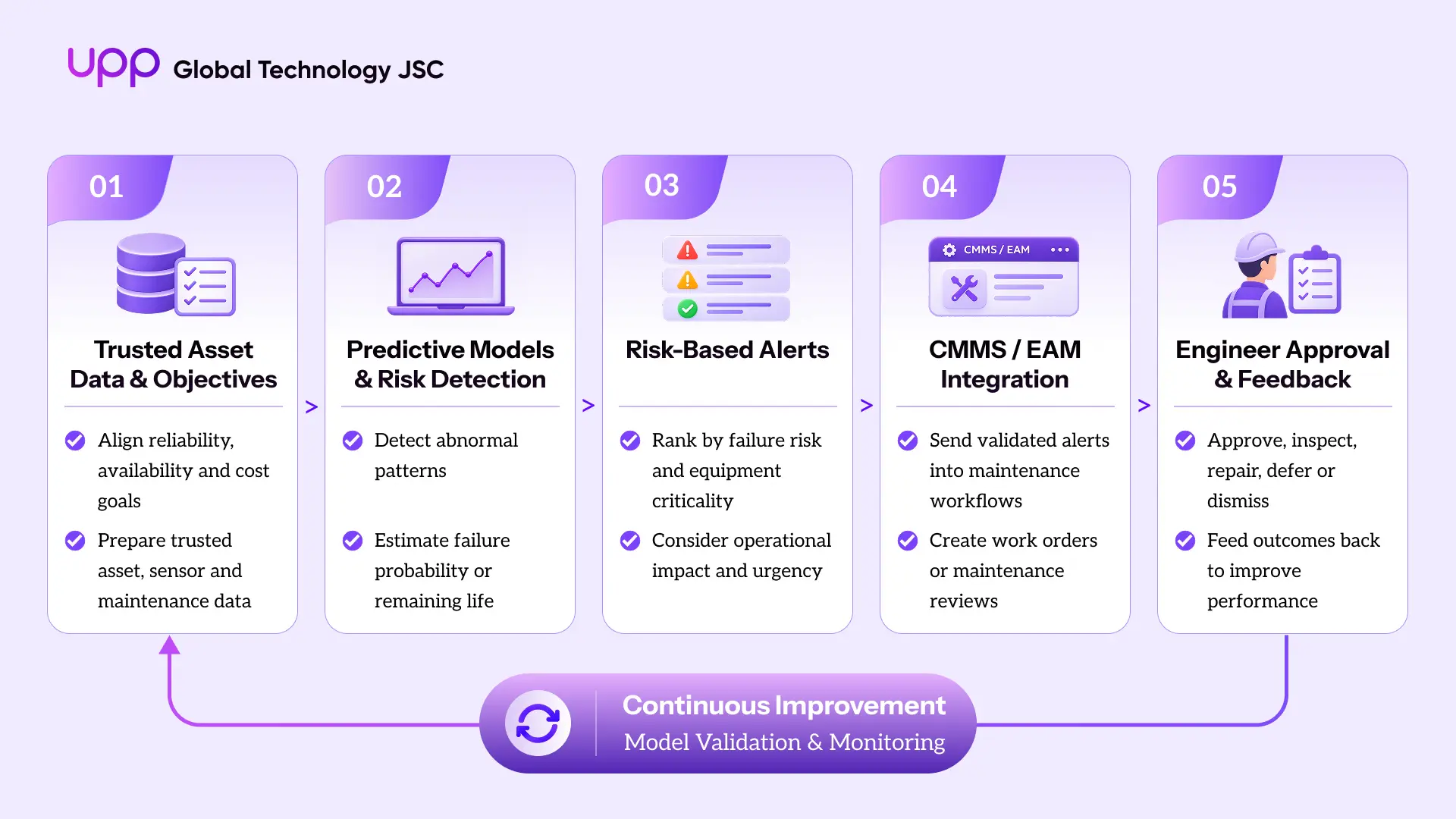
Predicting equipment failure is only one part of effective predictive maintenance. The operational value comes from connecting AI-generated insights with existing maintenance processes so that identified risks can be investigated and addressed.
In energy operations, effective AI integration requires connecting predictive models with trusted asset data and existing maintenance systems while keeping engineers responsible for operational decisions. A practical workflow begins with defining maintenance objectives and preparing reliable data, then moves through risk prediction, prioritized alerts, work-order integration, and engineer-approved action.
>> Discover how UPP's AI Consulting & Integration services turn AI insights into practical business actions.
Risk-Based Maintenance Alerts
Once an AI model identifies an anomaly or estimates a failure risk, its output must be translated into information maintenance teams can act on.
Not every prediction requires immediate intervention. Alert prioritization can consider estimated failure probability, equipment criticality, operational impact, and the potential consequences of delayed maintenance.
For example, an elevated risk score for a critical power transformer may require faster investigation than a similar score for a less essential asset with available redundancy. By combining prediction results with business and operational context, teams can prioritize the issues requiring the greatest attention.
CMMS/EAM Integration
AI predictions become more actionable when they are connected to existing Computerized Maintenance Management Systems (CMMS) or Enterprise Asset Management (EAM) platforms.
Through appropriate system integration, validated AI alerts can be transferred to maintenance systems using APIs, middleware, or other supported interfaces. Depending on the platform and approval rules, the integration may create a proposed work order, attach supporting equipment data, or initiate a maintenance review.
A work order could include the affected asset, detected anomaly, estimated risk level, and relevant sensor trends. Maintenance planners can then use their existing processes to schedule inspections, assign technicians, and track corrective actions.
This approach connects predictive maintenance with established enterprise workflows rather than introducing a separate system that engineers must monitor independently. The integration design should account for legacy-system limitations, data security, and the operational requirements of each organization.
Engineer Approval and Feedback
In safety-critical energy operations, AI-driven predictions should support engineering judgment rather than replace it.
Engineers review alerts, examine supporting measurements, and assess whether maintenance is necessary. They may approve an inspection, request additional diagnostics, schedule a repair, or dismiss an alert when operating evidence does not justify intervention.
Once maintenance activities are completed, work-order outcomes and inspection findings provide valuable feedback. Teams can compare predictions with actual equipment conditions, investigate incorrect alerts, and identify opportunities to improve model performance.
This feedback should support a controlled AI operations process involving performance monitoring, model validation, and updates where appropriate. Together, engineer approval and continuous monitoring help keep predictive maintenance accountable, traceable, and aligned with operational requirements.
Measuring Predictive Maintenance Performance
The success of predictive maintenance should be measured through both prediction quality and operational outcomes. A technically accurate model may still deliver limited business value if alerts arrive too late, maintenance teams cannot act on them, or predictions remain disconnected from existing workflows.
Energy operators can evaluate performance through four practical KPIs:
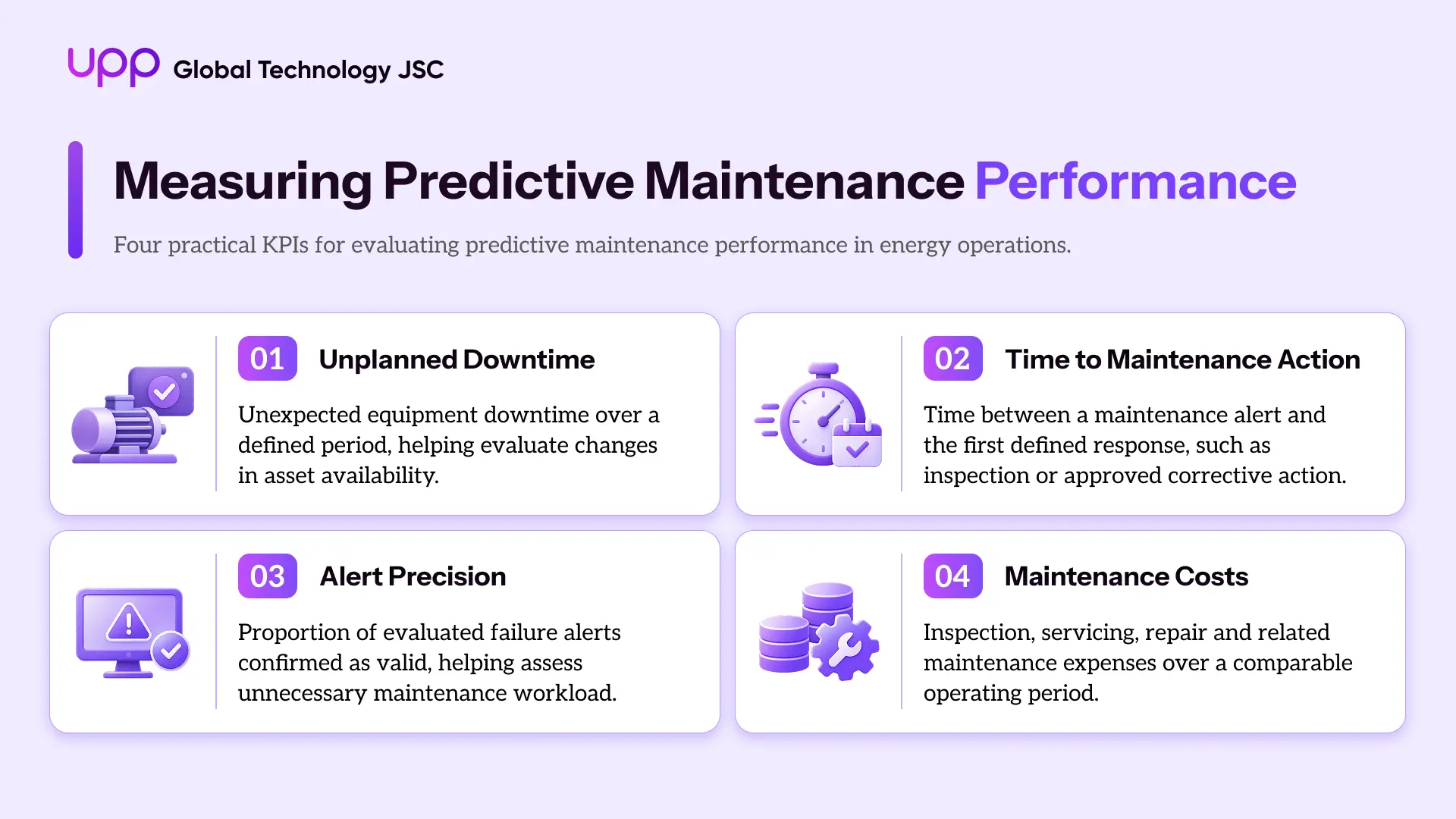
These indicators should be assessed against an established baseline and interpreted together. For example, lower maintenance costs are not necessarily an improvement if missed failures or equipment downtime increase.
Effective maintenance optimization balances asset reliability, timely intervention, operational safety, and cost efficiency. By combining maintenance KPIs with ongoing AI model evaluation, operators can determine whether predictive maintenance is producing useful decisions and identify where further improvements are needed.
Conclusion
Predictive maintenance helps energy operators identify equipment risks early and make informed maintenance decisions. By integrating predictive AI models with operational data and existing maintenance systems, organizations can turn failure-risk insights into timely, engineer-approved actions that support operational reliability.
FAQ
1. How is predictive maintenance different from preventive and reactive maintenance?
Reactive maintenance addresses equipment failures after they occur, while preventive maintenance follows fixed schedules or usage intervals. In contrast, predictive maintenance uses equipment data and analytics to identify potential failures and determine when maintenance is needed.
2. What data is needed for AI-driven predictive maintenance?
Predictive maintenance requires sensor data, equipment operating conditions, asset history, and maintenance records to detect anomalies and estimate failure risks.
3. Which energy assets can benefit from predictive maintenance?
Predictive maintenance can support wind turbines, generators, transformers, industrial pumps, and other critical energy equipment by identifying early signs of deterioration.
4. How can AI predictions be integrated into energy maintenance workflows?
Validated AI-generated alerts can be transferred to existing CMMS/EAM systems to initiate maintenance reviews or proposed work orders. Engineers then assess the evidence and approve appropriate actions.
5. How can energy operators measure predictive maintenance performance?
Key metrics include unplanned downtime, time to maintenance action, alert precision, and maintenance costs, helping operators evaluate reliability and maintenance efficiency.
Tags cloud
Newsletter
DISCOVER MORE






















































































































































LET’S TALK...
Content delivered to your inbox


ENTER YOUR EMAIL
YOU WANT TO...


Hanoi, Vietnam
Web3 Tower, No. 15, Alley 4, Duy Tan, Cau Giay, Hanoi, Vietnam