Multi-Agent System: How AI Agents Collaborate to Solve Complex Problems (Part 1)
Date
October 15th, 2026
Reading Time
7 mins
As business processes become more complex, organizations are increasingly exploring a multi-agent approach in which multiple specialized AI agents can work together, divide responsibilities, exchange information, and coordinate actions across tools, data, and workflows.
This approach is known as a multi-agent system (MAS), and it is becoming a core pattern in modern agentic AI because it allows organizations to move beyond single-task assistants toward coordinated, role-based automation.
The idea is particularly relevant as organizations move from simple AI-assisted tasks toward more autonomous agentic AI workflows. A multi-agent system can distribute multiple responsibilities among several specialized agents. One agent may act as a researcher, another as an analyst, another as a writer, and another as a reviewer, while an orchestration layer coordinates their work.
Frameworks such as CrewAI make it possible to build teams of specialized agents, while emerging protocols such as Model Context Protocol (MCP) and Agent-to-Agent (A2A) are making it easier for agents to interact with tools, data, and other agents across different systems. Related platforms and ecosystems, including Claude, OpenClaw, and Agentforce multi-agent, also help illustrate how multi-agent architectures are moving into practical enterprise use.
In this two-part series, Part 1 focuses on the fundamentals of multi-agent systems, while Part 2 will explore how these agents are orchestrated and connected in practice.
Related article: AI Integration Services in Australia: Moving from Pilot to Production
What Is a Multi-Agent System?
A multi-agent system is an architecture in which multiple autonomous or semi-autonomous AI agents work together to complete tasks that are too complex, broad, or dynamic for a single agent to handle efficiently. Instead of relying on one large, general-purpose agent, a multi-agent approach breaks a problem into smaller responsibilities and assigns them to specialized agents that can reason, act, communicate, and coordinate.
In artificial intelligence, a multi-agent system consists of several agents that interact within a shared environment. Each agent typically has a defined goal, access to specific tools or data, and the ability to make decisions based on context. These agents may collaborate, negotiate, delegate work, or validate each other’s outputs depending on the design of the system.
For example, in a content production workflow, one agent may research the topic, another may outline the article, a third may draft the content, and a fourth may review the final version for accuracy, tone, and SEO quality. This division of labor makes multi-agent systems especially useful for complex workflows that require specialization and quality control.
Why Multi-Agent Systems Matter
Single-agent systems can be effective for simple tasks, but they often struggle with large workflows because one agent must manage too much context, too many tools, and too many decisions at once. A multi-agent architecture helps reduce this overload by distributing work across focused agents. This can improve scalability, reliability, transparency, and execution speed.
-
Specialization: Each agent can focus on a specific role, such as research, planning, coding, analysis, or review.
-
Parallel execution: Multiple agents can work at the same time, reducing total processing time.
-
Better quality control: Reviewer or evaluator agents can check the work of other agents before output is finalized.
-
Modularity: Individual agents can be replaced, upgraded, or adjusted without redesigning the entire system.
-
Resilience: If one agent fails, the system can reroute tasks or rely on fallback agents.
Key Components of a Multi-Agent System
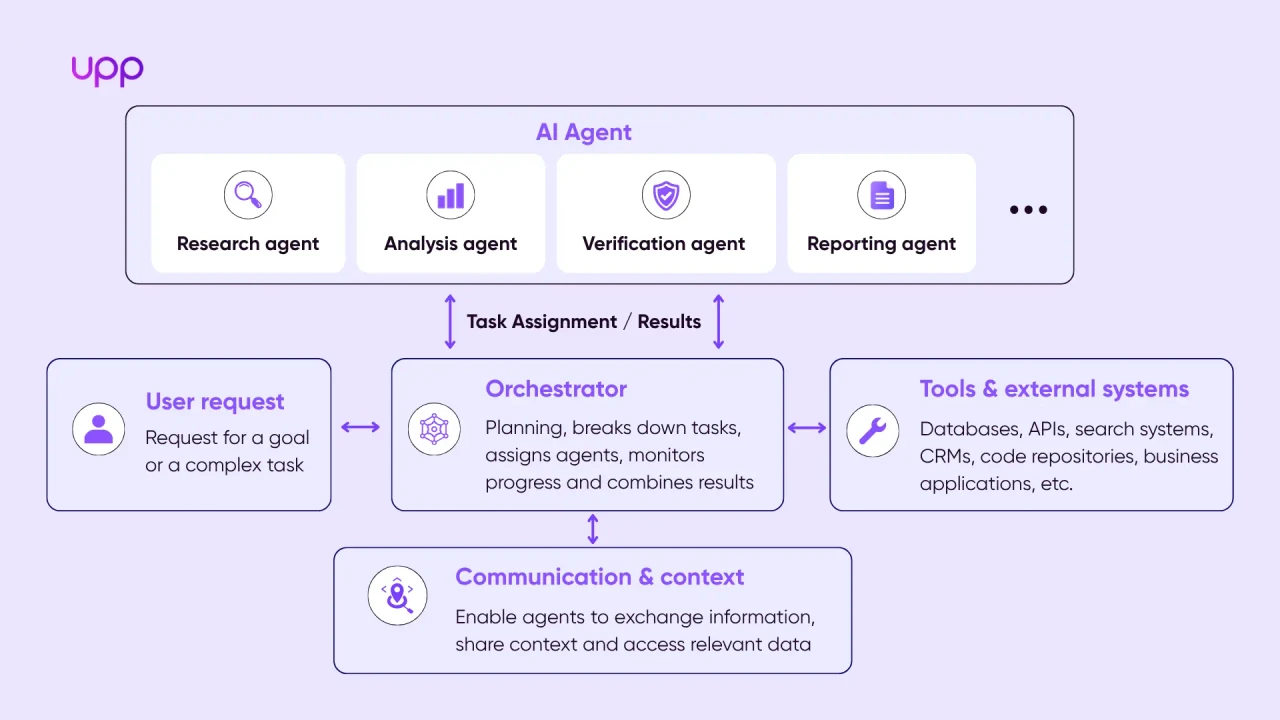
A multi-agent system is more than a collection of AI models. It requires several components that determine how AI agents reason, communicate, access information, and execute tasks within a coordinated agentic AI architecture.
1. AI Agents
At the center of the system are the individual AI agents. An agent generally combines an AI model with instructions, context, tools, memory or state, and a mechanism for deciding what to do next.
In a multi-agent architecture, agents are usually assigned different roles, such as research, data analysis, customer support, coding, strategy, or review. The objective is not to create as many agents as possible, but to separate responsibilities when the difference in expertise, tools, data, or permissions creates a meaningful architectural benefit.
Related Article: AI Assistants vs AI Agents: What are the differnences?
2. Agent Roles and Instructions
Each agent needs a clearly defined role. A good agent definition typically specifies:
-
Its objective
-
The tasks it is responsible for
-
The information it can use
-
The tools it can access
-
The format of its output
-
The conditions under which it should ask for help or escalate
Clear role definitions reduce unnecessary overlap and make the overall workflow easier to test. For example, a research agent should not simultaneously be responsible for approving financial transactions simply because it has access to the relevant tools.
3. Orchestrator
The orchestrator coordinates the work of the agent team.
Depending on the architecture, the orchestrator may be:
-
A dedicated AI agent
-
A deterministic workflow engine
-
A rule-based router
-
A hybrid system combining code and AI reasoning
The orchestrator may receive the original request, break it into subtasks, select appropriate agents, manage dependencies, and combine the resulting outputs.
A common architecture is a primary-agent pattern, where one agent acts as the main interface while delegating specialized work to secondary agents. Salesforce's Agentforce multi-agent orchestration follows this general model and shows how enterprise platforms can structure agent teams around customer, sales, service, and operational workflows.
4. Communication Layer
Agents need a reliable way to exchange information. Communication can be as simple as passing a structured result from one task to another, or as sophisticated as allowing independent agents to discover capabilities and collaborate dynamically.
For agents inside a single controlled application, the communication mechanism may be built directly into the orchestration framework.
When agents belong to different systems or vendors, open protocols such as MCP (Model Context Protocal) and A2A (Agent-to-Agent) become increasingly relevant because they provide a common way to describe capabilities, communicate about tasks, and exchange results.
5. Tools and External Systems
Agents become useful when they can interact with systems outside the model itself. These systems can include databases, CRM platforms, enterprise applications, APIs, search services, file repositories, code repositories, and analytics platforms.
The agent can reason about what needs to be done, while a tool gives it the ability to retrieve information or perform an action. Separating reasoning from execution also makes it easier to apply permissions and approval rules to actions that have real business consequences.
6. Memory and Context
Agents also need access to relevant context.
This can include:
-
Conversation history
-
Previous tasks
-
Customer information
-
Business rules
-
Documents
-
Previous agent outputs
-
Long-term memory
In a multi-agent system, context management becomes more complicated because the system must determine which information each agent actually needs.
Passing everything to every agent can increase token consumption and latency while also introducing irrelevant information. A well-designed system therefore treats context as something to be selectively managed rather than automatically shared everywhere.
7. State and Task Management
Complex tasks may take multiple steps or continue over an extended period, so the system needs to track the status of work. This can include completed subtasks, pending work, dependencies, agent outputs, errors, retries, and human approvals.
State management is particularly important for long-running workflows in which an agent cannot complete the entire task within a single interaction. It allows the system to resume work, understand what has already happened, and prevent unnecessary repetition.
8. Observability and Governance
As the number of agents increases, understanding what happened inside the system becomes increasingly important. Enterprise deployments also require governance covering authentication, authorization, data access, auditability, and human oversight. Observability and governance should therefore be designed into the architecture rather than added only after problems occur.
Multi-Agent Systems vs. Single-Agent Systems
A single-agent system generally relies on one AI agent to interpret the user's request, reason through the task, use available tools, and produce the final result. This approach can work well when the workflow is relatively straightforward or when the same type of reasoning is required throughout the task.
A multi-agent system, on the other hand, distributes responsibilities across multiple agents. Each agent can focus on a particular task or domain, and the system coordinates their interactions.
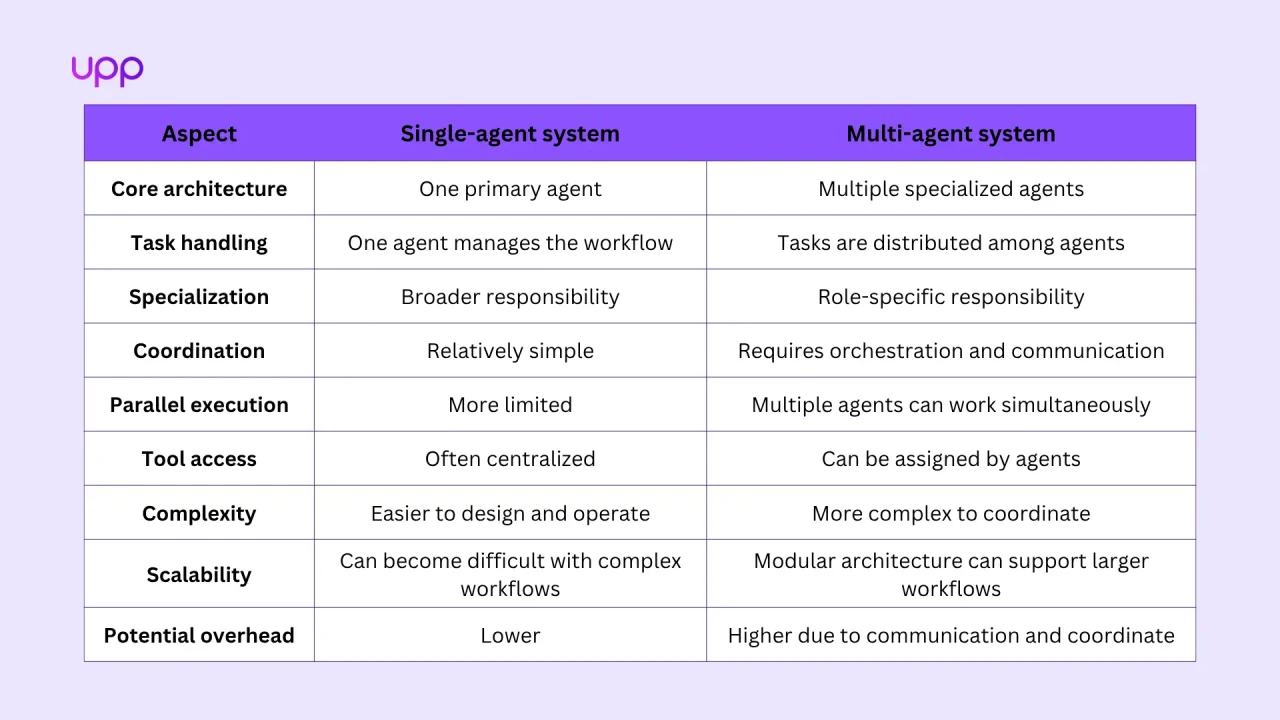
The choice therefore depends on the structure of the problem. Multi-agent architecture becomes particularly relevant when a workflow contains multiple specialized responsibilities, requires different tools or permissions, or benefits from parallel execution and independent validation.
Examples of Multi-Agent System Use Cases
Multi-agent architectures can be applied to a wide range of business and technical workflows. The exact design depends on the domain, but the underlying principle of dividing complex responsibilities among specialized agents remains similar, whether the system is built with CrewAI, integrated with Claude, connected through OpenClaw, or deployed in an enterprise environment such as Agentforce multi-agent.
-
Software development: One agent writes code, another reviews it, another tests it, and another prepares deployment documentation.
-
Research automation: Agents can gather sources, compare findings, summarize insights, and flag contradictions.
-
Customer support: A routing agent can classify requests and delegate them to specialist agents for billing, technical issues, or product guidance.
-
Marketing operations: Agents can research keywords, draft content, optimize SEO, generate social posts, and review brand consistency.
-
Business analysis: Agents can collect data, build summaries, identify trends, and prepare executive-ready recommendations.
Challenges and Best Practices
Although multi-agent systems offer major advantages, they also introduce new challenges. Poorly designed systems can become difficult to monitor, expensive to run, or prone to inconsistent outputs. Clear roles, strong governance, feedback loops, observability, and disciplined multi-agents orchestration are essential for successful implementation.
-
Define each agent’s role and decision boundaries clearly.
-
Use orchestration rules to control task flow and prevent circular delegation.
-
Keep agent communication structured and auditable.
-
Validate important outputs with reviewer or evaluator agents.
-
Monitor cost, latency, accuracy, and failure points over time.
Conclusion
Multi-agent systems represent a shift from using AI as a single assistant toward designing AI as a collaborative system of specialized agents. By dividing complex workflows into smaller responsibilities, multiple agents can work sequentially or in parallel, use different tools, exchange information, and contribute to a shared objective.
At the same time, multi-agent architecture introduces additional requirements for orchestration, communication, security, cost management, and observability. The key challenge is therefore not simply creating more AI agents, but designing an agentic AI system in which those agents can work together reliably.
Understanding this foundation provides the starting point for exploring the technical layer behind multi-agent systems. The next article will examine multi-agents orchestration, including how agents communicate, how architectures are structured, and how technologies such as MCP, Model Context Protocol, A2A, Agent-to-Agent, CrewAI, Claude, OpenClaw, Agentforce multi-agent, and other agent frameworks and platforms fit into the emerging AI ecosystem.
This concludes Part 1 of our series on multi-agent systems. Stay tuned for Part 2 where we will move to the technical layer, exploring how protocols such as MCP and A2A connect AI agents with tools, data, and other agents.
Newsletter
DISCOVER MORE


























![[Recap] UPP Global Technology JSC Establishing Anniversary](/homepage/news-section/new-4.webp)




















LET’S TALK...
Content delivered to your inbox


ENTER YOUR EMAIL
YOU WANT TO...


Hanoi, Vietnam
Web3 Tower, No. 15, Alley 4, Duy Tan, Cau Giay, Hanoi, Vietnam